
Product Positioning: What it is & How to do it Effectively? (2023–24)
Whether you’ve finished product development or you’re just at the ideation phase, your product positioning strategy will determine how well…

Whether you’ve finished product development or you’re just at the ideation phase, your product positioning strategy will determine how well your business grows.
With all the multifaceted intricacies of marketing, businesses often struggle to identify where product positioning would fall into the picture. However, if executed correctly, it could give you the edge needed to beat giants in your industry and help your business root firmly.
This article will cover everything you need to know about product positioning; what it is, and how to plan, implement, and execute it.
What is Product Positioning? (with examples)
Product positioning is a concept where a business showcases a product as a unique set of benefits tailored for a specific audience. Here, the goal is to stand out for a particular crowd by conveying that the product is made “specially” for them.
Example 1: Shoe Brands
When you think of sports shoes, a set of brands come to your mind; Nike, Adidas, Sketchers, etc. While these brands are big enough to create their own class of shoe wear, they stay on top of their customers’ minds because they continuously position their products as sportswear through various marketing means.
Odds are you wouldn’t think about these brands when looking for hiking boots. Brands like Woodland and Keen have already positioned themselves as best for soft-adventure sports.
Example 2: Unified Communication Networks
Slack and Discord have similar functionality (communication) but are perceived distinctively because both serve different purposes. Slack offers a unified communication service for businesses, while Discord is an online community platform.
Slack gives greater authoritative control, like transparency options, to admins because the software is built for “professional environments”. And while Discord can work well in a corporate atmosphere too, it does not and will never have tailored functionalities for a professional environment unless they’re able to alter their privacy policy while maintaining legislative compliance.
Brand Positioning (not the same as product positioning)
Brand positioning, while having similar traits to product positioning, is a different concept. The purpose of creating a brand perception is not necessarily to sell a product, but to embellish a business, making it more relatable for the target audience.
Relatability makes consumers familiar with your brand and further keeps your product on top of their minds when they’re presented with several buying options.
If you visit Slack’s homepage, you’ll see that their target audience comprises the corporate world, selling to them on the benefits of “improved productivity” and “streamlined operations”, whereas Discord is just an online community platform for hanging out.
When people who use both platforms think about Slack, they‘re instinctively adding work, professionalism, efficiency, prompt replying, work convenience, etc, to the thought conglomeration. All these mental associations are a result of the perception built around the brand — and product as well.
*Think of innovative ways you can build such perception around your product and brand.
For SaaS businesses, it may seem like both, brand and product positioning, are two convoluted concepts — but it is not true. There’s no harm in using them interchangeably for brands with a single product, but in general terms, they’re well understood only when looked at separately.
However, do keep in mind that both, product and brand positioning must be harmonious. Obviously, a brand image that doesn’t complement its products will fail to build recognition, trust, and authority.
How to Develop a Product Positioning Strategy?
Step 1: Identify Target Prospects and Market
A product made for everyone is made for no one. It’s important to clearly identify who you’re selling to by conducting market research, checking forums, learning from competitors, and conducting surveys.
Once you have all the data, you need to find which market segment most needs your product and how you can set yourself apart from others in that department. Once you know both, you’ll be able to tailor and perfect your brand messaging and product features.
Step 2: Find Your Competitors
Before analyzing your competitors, you need to know who they are. While you can find several free and premium research tools, I would recommend Similar web and majestic.
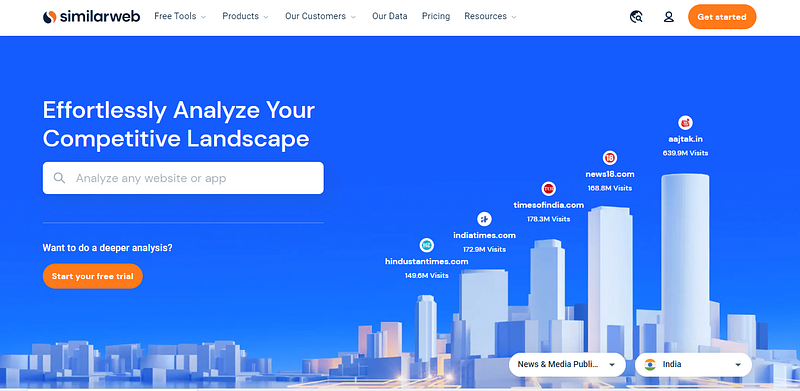
These websites will give you some insights on:
- Traffic sources
- Audience demographics and interests,
- Total visits & time spent on website
- Geography, and sales funnels of your competitors.
Identify not just their products, positioning, and marketing strategies, but also their strengths and weaknesses. It’ll help you find what additional value your product could put to the table that theirs’ don’t!
Step 3: Fill a Gap in the Market
Once you’ve learnt about your competitors (and their target audience), you can find a segment in the same market where your product can add value.
Do you know 40% of SaaS startups fail because there’s no market demand for their products? It is imperative to conduct thorough research and collect as much data as needed before product development.
If a small juice vendor buys lots of apples to juice every day, you could sell him precut apples. The feature would allow him to improve total efficiency, increase production, and make more sales a day! In addition, a 2019 U.S. study suggests that apple juices are liked the most followed by orange flavored juice.
Step 4: Communicate Unique Value and Benefits
Tell your prospects how choosing your product would benefit them more and emphasize what advantages your customers would have over those who use a different, less suited product.
Effective communication through the use of crisp, powerful, and brand persona-packed language will leave an indelible mark in your prospect’s mind.
Step 5: Create a Product Positioning Statement
A positioning statement is an important tool marketers refer and use to share briefs with their teams. An effective brief, then, can be used as a reference for creating marketing material in the form of articles, social media posts, advertisements, sales pages, etc.
Here’s a generic product positioning statement template you can use to define your ideal prospects, USP, and main benefits of your product.
For [Target Audience], [Brand] is the [Category] that provides [Unique Value/Benefit] unlike [Competitor/Alternative] by [Points of Differentiation].
You can add more to this based on your niche and market. Also remember that a positioning statement is not enough. You must also prepare product proposition, features, and communication during the prelaunch phase of your SaaS startup.
Product Positioning Strategy For Small Businesses
Many small businesses don’t have enough monetary backing to survey consumers at scale or experiment with retargeted advertisements. Here are some alternate methods for small scale research:
- Online Surveys: Use free or low-cost survey tools like Google Forms or SurveyMonkey to create targeted surveys and gather feedback from your target audience. Ask questions about their needs, preferences, and perceptions related to your product or industry. This can provide valuable insights into how to position your product effectively.
- Social Media Listening: Monitor social media platforms where your target audience is active. Pay attention to conversations, comments, and reviews related to your product or competitors. This can help you understand their opinions, pain points, and desires, which can inform your positioning strategy.
- Competitor Analysis: Conduct a thorough analysis of your competitors’ positioning strategies. This can involve researching their websites, social media presence, advertising campaigns, and customer reviews. Identify gaps or areas where your product can differentiate itself, allowing you to position it uniquely in the market.
- Customer Interviews: Reach out to existing customers and schedule brief interviews or phone calls to gather qualitative insights. Ask open-ended questions about their motivations, decision-making process, and why they chose your product over others. This qualitative data can provide valuable insights into your brand’s positioning strengths and weaknesses.
- Online Reviews and Ratings: Analyze online reviews and ratings of your product and your competitors’ products. Look for common themes, positive aspects, and areas where improvements can be made. This feedback can help you refine your product positioning based on customer perceptions and expectations.
- Focus Groups or User Testing: Organize small focus groups or user testing sessions with your target audience. This can be done in-person or online. Present your product and gather direct feedback for initial reactions.
- Website Analytics: Use free tools like Google Analytics to analyze website data and user behavior. Look for patterns in traffic, page views, and conversion rates. This information can provide insights into the effectiveness of your current positioning and messaging.
- Industry Reports and Publications: Explore industry reports, publications, and market research studies that may offer relevant data and insights. Some reports may require a fee, but there are often free resources available that can provide valuable market information and positioning trends.
Some Types of Product positioning
Some brands emphasize performance (tesla), some stand out by charging a premium (Dollar shave club), some flaunt reliability (BWM), and some boast their costumer persona to create a bandwagon effect (Nike).
Ultimately, your product should be positioned according to its unique selling point and what major advantages it’ll give consumers that your competitors cannot offer.
How to Implement & Execute Positioning Strategy
A positioning strategy will work when it’s consistently applied in marketing material. When you align your business’s marketing and messaging with it, it helps your audience/consumers familiarize themselves with your business, and this further helps keep your brand on top of their minds.
Following 3 points will help establish a strong product positioning foundation for your business.
#1. Altering Positioning Strategy
While executing positioning strategies in a changing market, times will come when you’d have to improvise/make changes. And your costumers mustn’t see this change as an odd shift and defamiliarize themselves with your business.
It’s completely fine to monitor and adapt your positioning strategy. However, when modifying, think more of “brand evolution” than “change”. Ideally, the core values of your business should always remain unchanged. And if you want to make drastic changes, distribute them into transitory phases.
#2. Don’t Overlook Market Trends
It is also important to incorporate new data and findings into your strategies and improvise. As market continues to evolve, your target audience may become more likely to convert on newer channels, through newer means.
#3. Stay Away From The Feature Creep
Adding more and more attributes to your positioning statement will only make it worse for your target market and diminish consumers’ perception of your USP (unique selling point) because then, those consumers would need extra space (mental resources) to remember all the “general benefit” jargon. It is best to list out product attributes separately and not use it in marketing material directly.
Conclusion
In conclusion, product positioning allows businesses to differentiate themselves from competitors and communicate unique value to a specific target audience.
It is important to note that product positioning differs from brand positioning. While brand positioning aims to establish a brand’s authority and recognition, product positioning focuses on highlighting the unique benefits of a particular product.
To develop a product positioning strategy, you need to:
- Conduct market research,
- Analyze competitors,
- Find and fill a gap in the market
- Communicate your unique value and benefits to your audience.
A positioning statement serves as a tool to guide marketing efforts.
If you’re running a small businesses with limited resources, you can adopt alternate methods such as online surveys, social media listening, competitor analysis, customer interviews, online reviews, focus groups/user testing, website analytics, and industry reports.
So, in short, the heart of product positioning entails niching down (specializing) a product to eliminate most of your competition. When you do that, you’re excluding, not including, market segments and proving your specialty to those who need it most.
Need a content marketer who can help you strategically position your product through articles, emails, and social media posts? Hit me up!